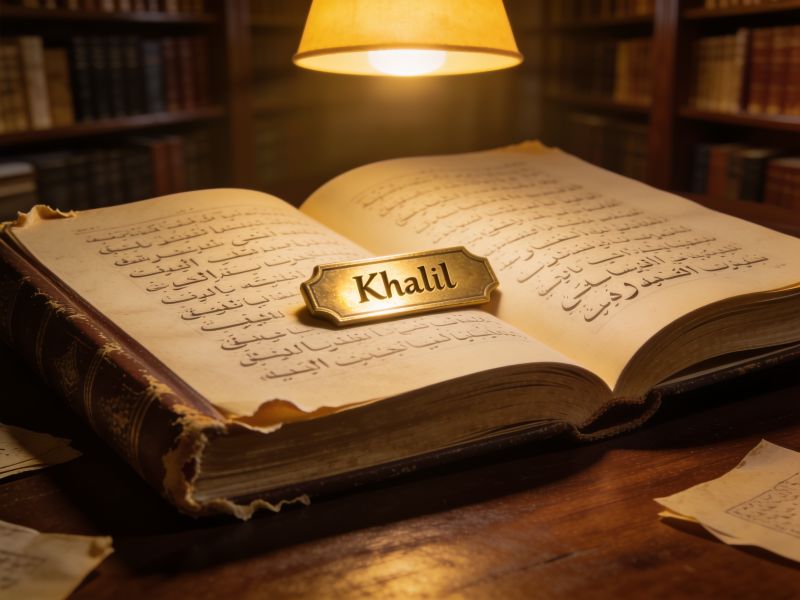
Khalil doesn't need an introduction in most of the places where it appears. Walk through a market in Beirut。a university corridor in Cairo, or a community center in Dearborn, Michigan, and you will hear it called out across a room. The name travels well, though not always smoothly. In Arabic, Khalil (خليل) means friend, close companion, or even intimate associate. That is not a soft, decorative meaning. It implies trust that has been tested, the kind that does not need constant reaffirmation. When a parent names a child Khalil, they are claiming a hope for that child's character, not just picking a pleasant sound.I first paid real attention to Khalil as a surname, not a given name. Khalil Gibran。
the Lebanese-American writer, sits in an odd corner of the literary canon. His book The Prophet has sold millions of copies since 1923, yet many English departments still treat it as a curiosity rather than serious literature. Gibran's Khalil was part of his full name, and the way it got dropped in Western editions says something about how names get compressed when they cross borders. I have a worn copy from a used bookstore in Dearborn, published in 1971, and the spine just says Gibran. The Khalil disappeared. That omission feels like a small erasure, repeated across thousands of library catalogs.Statistics on names are slippery, but the data I trust most comes from local records rather than global databases. In the United States, Khalil ranked outside the top 500 baby names for most of the twentieth century. Around the 1990s, it began climbing. By the 2010s, it sat comfortably in the top 300. That shift tracks with immigration patterns from the Levant, North Africa, and South Asia。but also with a broader American willingness to choose names that carry visible religious or cultural weight. A Khalil I know in Chicago, born in 2003, told me he spent years correcting substitute teachers who pronounced it KAY-lil. He stopped bothering in high school. Now he introduces himself as Khalil, one syllable, the way his grandmother says it. That small refusal to translate himself is a kind of quiet dignity.Pronunciation varies more than most people expect. In Egyptian Arabic, the second syllable gets a heavy, throaty kh sound that English speakers often turn into a plain h. In Moroccan Darija。it can sound almost like Khlil, with the vowel swallowed. In Turkish, the same root becomes Halil, a completely different spelling. I find this fascinating because Khalil is not one thing. It is a family of sounds linked by a shared root, shaped by the mouths that carry it. A name that resists a single correct rendering is harder to erase.What stays constant is the weight of the meaning. Friend. Close companion. In a time when the word friend has been flattened by social media into a count and a click, Khalil insists on something older and more demanding. I do not think that is sentimental. It is just accurate. Names hold standards. A Khalil I met in Amman, a taxi driver in his sixties, put it plainly: "My father told me, if you are named friend, you must be one." He laughed after he said it。but he did not take it back.